Your identity, your tattoo, your future. Introducing: Proof-of-Ink.
Parity Technologies is gearing up to launch a groundbreaking Web3 individuality solution, which many see as a critical step toward making Web3 mainstream. Dubbed “Proof-of-Ink,” this innovation will allow users to prove their digital identity in a way that preserves privacy.
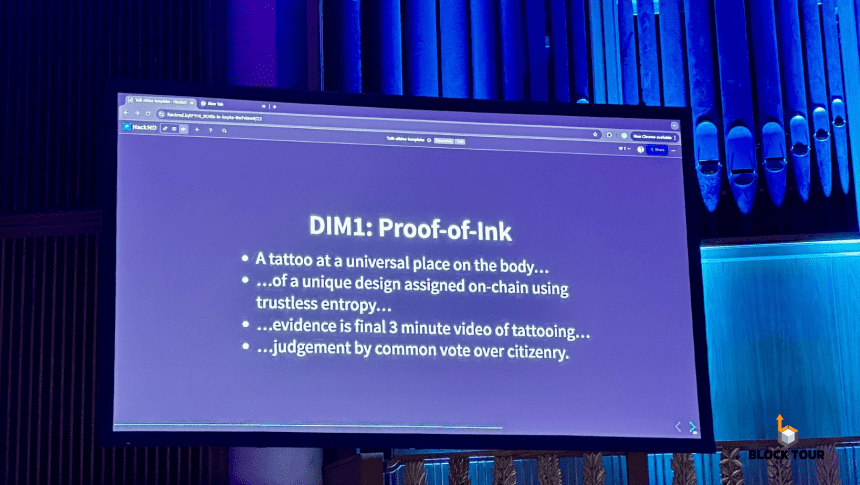
The key? A unique tattoo that serves as a digital citizenship marker.
Slated for release in the fourth quarter of 2024, Proof-of-Ink was announced by Gavin Wood, co-founder of Ethereum, Polkadot, and Kusama, during his keynote at the Web3 Conference in Berlin.
Wood shared:
“We are able to deploy the baseline palette and launch the app at some point this year, hopefully in the final quarter… We are aiming to launch the other two mechanisms next year.”
Mainstream adoption is essential for any technological shift, and experts like Wood believe that Web3 could lead to a more decentralized and user-focused internet, a vision of a public good that benefits all of humanity.
In the latest crypto news, Proof-of-Ink aims to enhance privacy through a unique design tattooed on a specific part of the body. This uniform placement is crucial for ensuring individuality and privacy, with each tattoo design being algorithmically generated and uniquely signed on the blockchain.
To participate, users will need to spend a small balance of Polkadot (DOT) tokens—currently valued at $4.72—or potentially use vouchers circulated within the Web3 community before the app’s launch. This mechanism is designed to combat spam through Sybil resistance.
Finally, users will upload a video capturing the last three minutes of the tattooing process, which will serve as the ultimate proof of their Web3 identity. Digital individuality solutions like Proof-of-Ink could be a game-changer for Web3 adoption, provided they offer true financial privacy. Wood emphasized that the goal is to move away from signatures tied to transactions and instead use proofs that don’t reveal the user’s identity.
Wood also pointed out that the importance of financial privacy was first highlighted by whistleblower Edward Snowden, especially in light of past financial censorship instances like Visa and Mastercard suspending payments to WikiLeaks in 2010.